

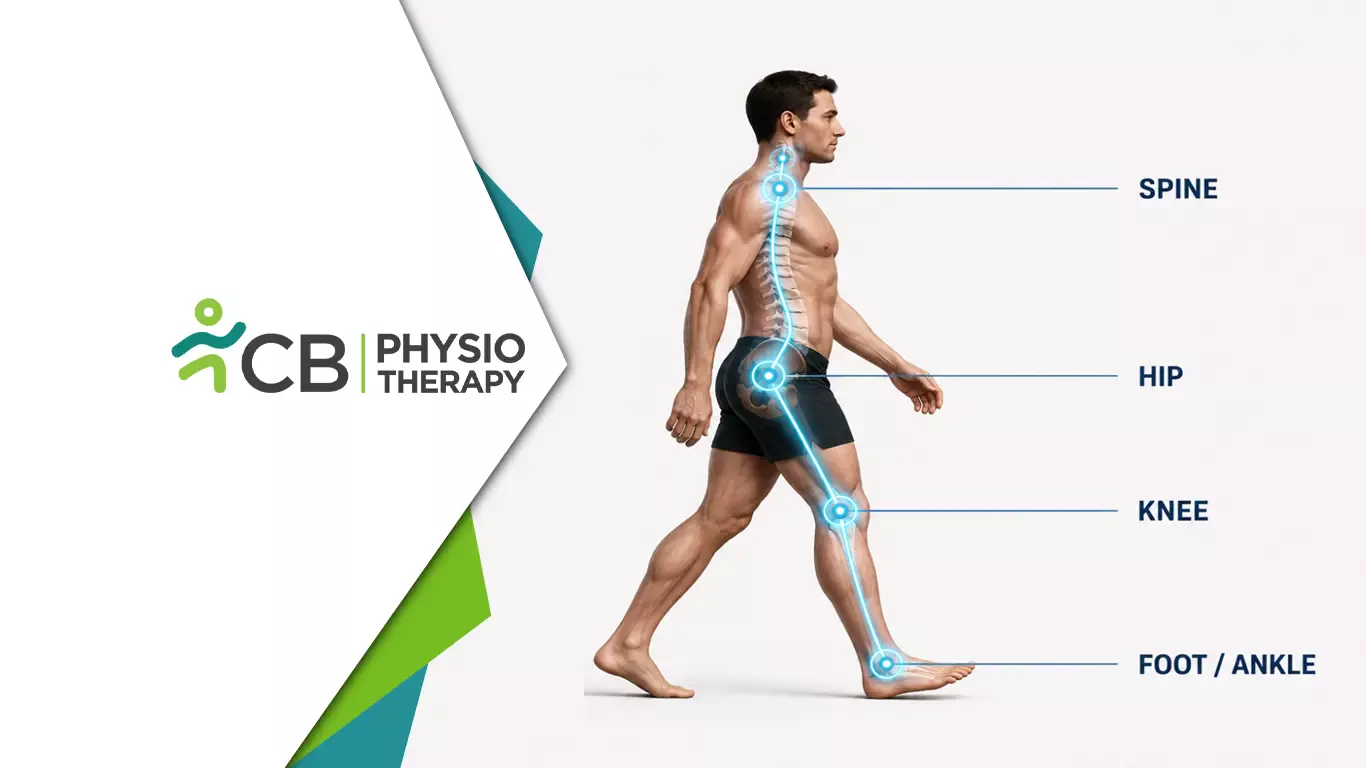
When people experience knee or back pain, they usually look for the cause around the painful area. Knee pain may be blamed on the knee joint, while lower back pain is often associated with poor posture, prolonged sitting, or lifting something incorrectly.
But did you know that your feet can
sometimes play an important role in how your knees, hips, and lower back move?
Your feet are the foundation of your body.
Every time you stand, walk, run, or climb stairs, they absorb and transfer
forces through your legs and up toward your spine. When the feet are weak or do
not function properly, it may affect the way the rest of your body moves.
This is often described as the foot-to-spine connection.
How Do Weak Feet Affect the Rest of the Body?
Your feet are designed to provide both
stability and flexibility. They help absorb shock when your foot hits the
ground and provide a stable platform when you push off.
If the muscles supporting your feet are weak,
your foot may have difficulty controlling these movements. In some people, this
can contribute to excessive inward rolling of the foot, commonly called overpronation.
When the foot changes position, the ankle and
lower leg may also change their movement. This can influence the alignment and
mechanics of the knee and hip.
Over time, repeated changes in movement
patterns may contribute to increased stress on certain muscles and joints.
This doesn't mean that weak feet automatically
cause knee or back pain. Pain is usually influenced by several factors,
including muscle strength, joint mobility, activity levels, previous injuries,
body mechanics, and overall physical conditioning.
The Connection Between Your Feet and Knees
Think of your legs as a chain. The foot is at
one end, while the hip is at the other.
If the foot does not provide adequate
stability during walking or running, the muscles higher up the leg may need to
compensate.
For example, excessive inward movement of the
foot may be associated with changes in the movement of the shin and knee.
Depending on the individual, this may place additional demands on the muscles
and tissues around the knee.
This is one reason physiotherapists don't
always examine only the painful joint.
If you have persistent knee pain, your
physiotherapist may assess your:
·
Foot and ankle
movement
·
Foot muscle
strength
·
Walking and
running pattern
·
Knee alignment
and movement
·
Hip strength and
control
·
Balance and
coordination
Looking at the entire movement chain can help
identify factors that may be contributing to your symptoms.
Can Weak Feet Contribute to Back Pain?
The connection between the feet and lower back
is less direct, but it can still be important.
Your body constantly adapts to changes in the
way you stand and walk. If your feet and ankles have difficulty controlling
movement, this can influence the position and movement of the knees, hips, and
pelvis.
For some people, these changes may alter their
movement strategy and place additional demands on the lower back.
However, it is important not to assume that
foot weakness is the cause of every case of back pain.
Lower back pain can have many different
causes, and a proper assessment is needed to understand the factors involved.
What Are Signs Your Feet May Need Attention?
You may benefit from having your foot and
lower-limb mechanics assessed if you notice:
·
Your feet become
tired quickly when standing or walking
·
You frequently
lose your balance
·
Your arches
appear to collapse when standing
·
You have
difficulty standing on one leg
·
Your shoes wear
unevenly
·
You experience
recurring ankle, knee, hip, or lower-back discomfort
·
You struggle with
activities such as running, jumping, or climbing stairs
These signs do not necessarily mean that weak
feet are causing your pain. They simply indicate that a more complete movement
assessment may be useful.
Can Physiotherapy Strengthen Weak Feet?
Yes. In appropriate cases, physiotherapy can
include exercises designed to improve foot and ankle strength, mobility,
balance, and coordination.
Depending on your assessment, a
physiotherapist may recommend exercises such as:
·
Toe and arch
exercises: These can help improve control of the
small muscles within the foot.
·
Calf
strengthening: Strong calf muscles contribute to
ankle stability and efficient movement.
·
Balance
exercises: Single-leg balance and other
stability exercises can improve control throughout the lower limb.
·
Hip and leg
strengthening: Because the foot, knee, and hip work
together, strengthening muscles higher up the leg may also be important.
·
Gait and movement
retraining: Your physiotherapist may assess how
you walk, run, squat, or perform other activities and teach you more efficient movement
strategies.
The right exercises depend on the individual.
There is no single “best” foot exercise for everyone.
Don't Ignore the Foundation of Your Movement
Your feet may seem far away from your lower
back, but your body works as a connected movement system.
Weakness or poor control in the feet may
influence how forces are distributed through the ankle, knee, hip, and pelvis.
In some individuals, this can contribute to movement problems associated with
pain.
At the same time, foot weakness is only one
possible factor. The goal of physiotherapy is not simply to find one structure
to blame, but to understand how your entire body moves.
If you have persistent knee or back pain,
consider getting a professional assessment rather than treating only the
painful area. A physiotherapist can evaluate your feet, ankles, knees, hips,
and movement patterns to determine wlowehether they may be contributing to your
symptoms.
Strong feet provide a strong foundation for
movement — and better movement starts from the ground up.